China is indeed a very strange country for Bitcoin.
On one hand it is the biggest Bitcoin country in the world
With major exchanges and mining pools all here
With the most active chat groups with fake identities
On the other hand the government discourage its uses
You can hardly see any activities on the surface
Most major players prefer to remain anonymous
Well that’s what makes it all the more interesting
Believe me, it is very happening indeed around here
Only that they don’t want to be seen in public.
This is as Chinese as Chinese can be…
Is China saving Bitcoin, or destroying it?
I recently talked with Bobby Lee, CEO of BTCC, China’s first and biggest bitcoin exchange. It would be fair to call Bobby an optimist when it comes to Bitcoin in China and throughout the world.
“The great part is that in China, Bitcoin is very popular. There’s a lot of speculation, and a lot of mining activity, and a lot of traders,” he says. “There’s huge interest, demand, and activity in China.”
Mainland China is a big deal in the world of Bitcoin. A tremendous amount of “mining” – that is, the process of using computational power, often entire server farms’ worth, to discover new coins – is now done in the country. By some estimates, about 80 percent of the global mining market is now within the People’s Republic.
Bitcoin is also used in China in ways that it isn’t in other parts of the world. China already has very advanced infrastructure for epayments – namely WeChat Wallet and Alipay – so many Bitcoin holders don’t use the currency for daily transactions. Instead, they use it to scratch the itches that are typically off-limits to average Chinese citizens, like investments and currency conversions.
Bobby’s optimism on Bitcoin in China is not shared by everyone.
“Because people in China are buying and selling Bitcoin in boatloads, there’s a great liquidity in Bitcoin trading. It makes the prices much more stable,” Bobby says. “So bitcoin volatility has actually come down in the last two years – and that’s a great thing. You can fully attribute that to the fact that China is contributing liquidity.”
All good news, right? But Bobby’s optimism on Bitcoin in China is not shared by everyone.
The bad news
Back in January, (now former) Bitcoin developer Mike Hearn wrote an articlethat got quite a bit of circulation within the cryptocurrency community, and it wasn’t enthusiastic. (I reached out to Mike to comment on this article, but he declined.)
Dubbed “The Resolution of the Bitcoin Experiment,” the piece is essentially a list of reasons why Bitcoin is completely screwed. It got a bit of flak online – Gizmodo said, “Bitcoin has died – for the 89th time” and noted that declarations of Bitcoin’s death have happened every few months since the currency was first created. But some of its criticisms, especially those related to China, are worth taking seriously.
One is that China’s Great Firewall (GFW) censorship apparatus is wreaking havoc on Bitcoin’s technological infrastructure. Because so much of Bitcoin is transacted within China, and because connections from China to other countries are slowed by the GFW, the entire global network for Bitcoin is made slower.
A related criticism is that, according to Mike, China’s dominance of the global Bitcoin mining market has turned into a liability because the specific individuals in control of the country’s biggest mines are resistant to changes in the blockchain, the decentralized technology that makes all of Bitcoin work in the first place.
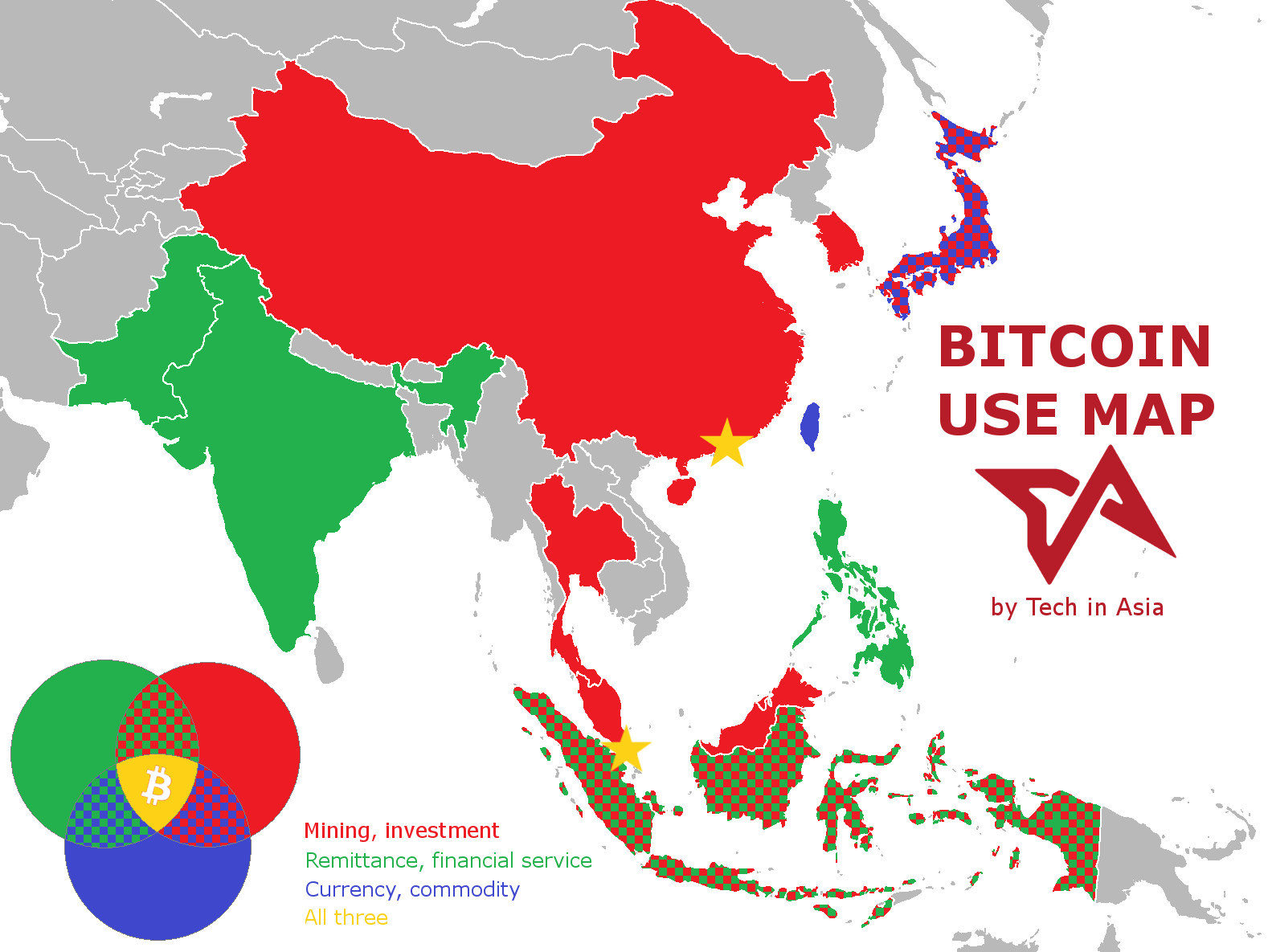
Bitcoin usage map, by Tech in Asia.
It’s hard to mention too much about the blockchain debate without falling into a 5,000-word rabbit hole, but the TL;DR version is that blockchain is the global ledger that keeps track of Bitcoin transactions to make sure everything is legit. The system wasn’t designed for the volume that’s currently being exchanged, so it has slowed down considerably – it can take more than 40 minutes for a transaction to go through.
Bobby agrees that there is a problem. “We’re running into the limits of how the software was designed seven years ago,” he says. However, he is optimistic that the cryptocurrency community will be able to find a solution.
It’s good to be open-minded
“China is one of the strong legs of the stool that’s supporting Bitcoin,” says Bobby. Those involved in Bitcoin in China – whether as miners, spenders, or anything in between – are part of both the currency’s biggest triumphs and most worrying problems.
Any solution to Bitcoin’s dilemmas will be one that takes China into account. That might mean restructuring blockchain while also keeping Chinese miners happy, or developing some sort of workaround to avoid latency issues caused by the Great Firewall.
But let’s say, hypothetically, that the powers that be behind Bitcoin (including some very powerful Chinese miners) fail to resolve the blockchain debate and the entire currency burns to the ground. Transaction times are through the roof, and users drop like flies. Even in that worst-case scenario, there would still be reason to be hopeful about the future of digital currencies more generally.
China is a place that’s begging for something *like* Bitcoin.
“We [BTCC] are agnostic,” Bobby says. He thinks that Bitcoin will continue to be the face of the digital currency movement, “but, as a company, we’re all about the technology […] Whether that’s Bitcoin-based, Litecoin-based, or something else.”
China has some characteristics that make it incredibly appealing to digital currency advocates – its paper currency isn’t easily exchanged, it’s difficult for normal citizens to invest, and the country is already very comfortable with digital payment platforms.
It’s a place that’s begging for something like Bitcoin – but time will tell whether it’s Bitcoin or a different cryptocurrency that finally cracks the code.
Forward from: By Erik Crouch, Is China saving Bitcoin, or destroying it?